
BOXER SHORTS AND GROOVE MUSIC: THE “SCHLAGERPINZ” AND HIS BAND ARE BECOMING INCREASINGLY POPULAR IN GERMANY
Just under two years ago, the “Schlager Prince” made his very first appearance in Würzburg. A lot has happened since then. A conversation about unusual autograph sessions, surprising encounters, flying boxer shorts, and deep gratitude. The wind whistles across the Laurentiusberg in Tauberbischofsheim on that frosty January evening, when the FN meets with the “Schlager Prince” for an interview for the second time since the band’s inception.
In the cold neon light of the rehearsal room, there’s no trace of the garishly colorful sequin glamour that usually surrounds the group. Everyone is wearing warm anoraks. Band leader Sven Schwab turns up the heat first. We quickly get down to business. One thing is particularly close to Sebastian Kelhetter’s heart: “Please include in the article that we’re incredibly grateful to the people who come to our concerts. Without them, none of this would be possible.” The band can hardly believe everything that’s happened in the meantime—where they’ve performed, who they’ve met.

THE SCHLAGER PRINCE & BAND
Just under 3,000 people at the “XXL Schlager Party” in Streutal near Mellrichstadt, 2,000 at the brewery festival in Bayreuth, and consistently 600 at the gigs at the “Homebase,” the Posthalle in Würzburg. The musicians rave about “meetings on equal footing” with stars like Michael Holm, Ross Anthony, Beatrice Egli, and Guildo Horn. Reality TV star Hubert Fella has declared himself an absolute fan of the band on his social media accounts. On Instagram, he listed five reasons why you absolutely should check out the “Schlager Prince.” Among other things, he writes: “The band puts on a unique stage show with great attention to detail. Their performance is simply electrifying.”
During our conversation in the studio, the band’s most important member just listens at first. “That’s typical of Manu,” the others say. Frontman and singer Manuel “Manu” Both, as always, holds back at first, letting the others do the talking and nodding when they speak of humility and gratitude. Sven Schwab recalls how, during the COVID-19 pandemic, his dream of forming a high-caliber Schlager band grew stronger: “As a singer, I always had Manu in mind for this. I had a hunch that this could be right up his alley.” When Sebastian Kelhetter says today that the band works so well largely because of Manu—that he draws people in from the very first song—he finds it rather embarrassing: “I have a really hard time handling praise. I just do my thing, but it’s nothing special. Every band member is just as important as I am.” It seems that all nine members haven’t quite realized the full extent of their success yet. But it didn’t just fall into their laps. After all, they don’t want to be labeled as a slapstick act and are doing everything they can to make sure that never happens. Steve says: “In terms of the quality of our performances, we’re at a level none of us has ever been at before. Everyone has played in other bands before, but this is something completely different and very challenging.” Sebastian Kelhetter adds: “When something looks easy, there’s often a lot behind it. We have songs with seven or eight key changes in our repertoire. That’s no small feat. Still, we never want to lose our sense of ease.”
The band’s set list includes hits like “Eine neue Liebe ist wie ein neues Leben” and “Ein Bett im Kornfeld,” as well as “Am Tag, als Conny Kramer starb” and “Über sieben Brücken,” which was celebrated in a special way in late December at the Baltic Sea resort of Boltenhagen. They traveled there by nightliner, since the “Schlager Prince” had been performing in Würzburg the night before. Cruising through the countryside in a tour bus was also a completely new experience for the nine friends. And a few other experiences—unprecedented up to that point—were added in 2023. For example, Manuel Both is now recognized on the street: “Before our show in Düsseldorf, I was walking through the city. Suddenly, a group of girls came up to me, and one of them said, ‘You’re the Schlager Prince, aren’t you?’ At first, I thought they were pulling my leg. When they then added that they were from Hamburg, I was really stunned, because we’ve never played there.” “Extreme” Experiences Just as extreme were the experiences in Mellrichstadt, where the band was honored to sign the town’s Golden Book in the presence of Mayor Michael Kraus: “After the show, security guards came over and asked us to come along to the autograph session. They cleared a path for us through the crowd. There were so many people gathered at our fan shop, waiting for us. It was just unbelievable for all of us.”
Sven Schwab adds: “We’d never experienced people wanting to take pictures with us before. And it was so funny how people would push past Burkard Schäffner and me to get a photo with Manuel—one of the most modest, reserved, and therefore most atypical singers there is. Sebastian Kelhetter thinks the stage persona and the private Manuel are two different people. Manu Both, who loves Michael Holm’s “Mendocino” just as much as his father does, laughs and says, “When I sing ‘…and it was summer,’ it can happen that I look a woman deep in the eyes while doing so. That’s just part of it. On stage, I’m the ‘Schlager Prince’—I’m there for everyone.” In an interview with the FN, he also reveals his trick for when he forgets the lyrics. “It just happened to me again in Boltenhagen during ‘Ein Bett im Kornfeld.’ I’ve definitely sung that a thousand times, but suddenly a verse was gone.” And what does he do then? “The lyrics are always lying next to the keyboardist. I’ll then dance over to him at the back. The band already knows what to do and makes room for me.”
Flying bras are nothing new for the band, but the black boxer shorts that landed on stage at the Posthalle in Würzburg last December were a whole different experience. “I picked them up, twirled them around a bit, and on the drive to Boltenhagen, we hung them up in the bus,” says Manu Both, and everyone laughs. “When we’re on stage, we forget everything else around us. And that’s exactly how it is for the audience, too,” says André Ditzenbach. Stephan “Steve” Hohnerlein adds: “All of us—the band and the audience as the ‘tenth man’—escape from reality. We slip into different roles and become someone else. But once we’re back in our regular clothes after the show, nobody’s interested in us anymore. Only Manuel still gets recognized even then.” “Decent and Nice” It’s important to the band to be “decent and nice.” “We don’t act like idiots; instead, we clean up after ourselves, for example, or bring the security guards a coffee sometimes. ‘No artist has ever brought the security guards a coffee before,’ they told us,” Steve recounts, adding after a short pause: “We’re not really artists, either. We’re just from Tauber.” Of course, the friends could tour with the Nightliner more often, but everyone also has a job and a family. “Besides,” says Gabriel Bauer, “back when we put the band together, we didn’t plan on playing 120 shows a year. We’re just friends who make music and have fun doing what we do.” Steve adds: “The past year has gone better than we ever dreamed. But just because we drove around the area in a tour bus once doesn’t mean we’re going to lose touch with reality. After our huge success in Mellrichstadt, we all had to go back to work on Monday. That really keeps us grounded.”
By Sabine Holroyd, Fränkische Nachrichten, Tauberbischofsheim.
Latest Posts
-
 We Rock, Queen
03.09.2026
We Rock, Queen
03.09.2026
-
The Romance of Lady Gaga – The Spectacular Lady Gaga Tribute Show
31.08.2026
-
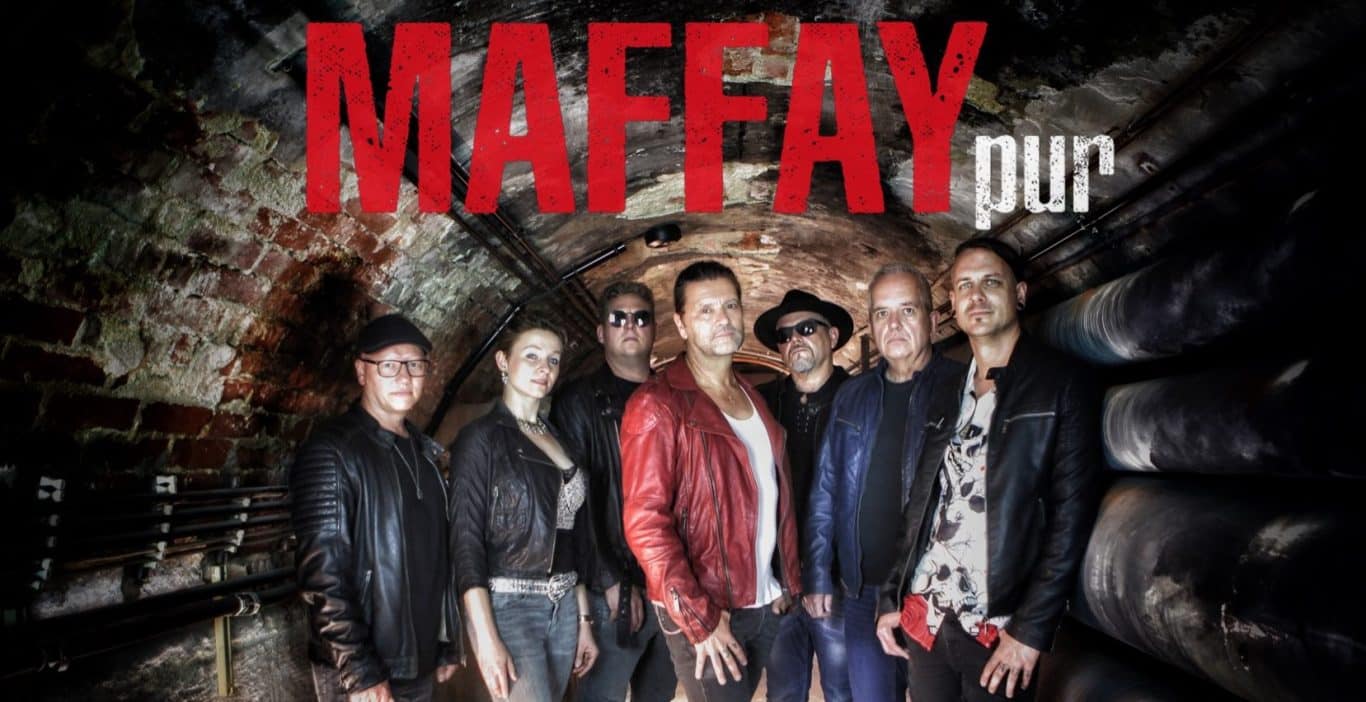
MAFFAYpur – The Peter Maffay Tribute Band Featuring All His Big Hits
13.07.2026
-
Status Quo Forever – The Ultimate Status Quo Tribute Band
24.06.2026
-
Taylor Swift and Ed Sheeran at Hessentag? Tribute show thrills fans
17.06.2026




Copyright 2003–2026 – AAOO Concerts, Owner: Wolfgang Allroggen – All rights reserved